Jun 8, 2007

He's Leaving Home

"Dude, lets go to Pakistan."
"Now? It's a little too late."
"Everybody's there. Last night at Pak."
"Sarkar's cutting tomorrow?"
Silence.
"Fuck. Yes. Sarkar's cutting tomorrow... Vipul also!"
"They're there right now. Let's go."

And so, Surd and I, on my bike rushed to Pak - to consume, one last time, the tea that kept me sane for three years. As I drove, helmetless, past policemen, I remembered the first time I went there, with Bailey, on the day before the CPC one mid-term (a night that would culminate in four of us standing in the middle of the Cauvery hostel quad screaming, "Takwani!!") and being fascinated by how a place this extraordinary in atmosphere could be tucked away in a quiet corner of Bangalore for this long.

For three years, four days a week on an average, Sarkar, Vipul, Spandan and myself with Singla, Senti, Amit, VP and other junior and senior visitors discussed life there over countless cups of chai and Classic Milds. And on that last night, when I reached Pak, I was overwhelmed by nostalgia. I somehow never thought that my non-smoking, vegetarian self could ever be so attached to a place that mainly serves young, dead animals and cigarettes to go with the chai! The days I didn't go there felt strangely empty. The days Sarkar and I didn't come back at 12.45 and sign in the gate three register as The Pope, or Simi Rose, or James Bond (with roll no 007), I usually sulked around the hostel like a little kid who had just lost a game of hide and seek.

Finally, the moment arrived. I had to leave Pak (officially called Gangondanahalli) for the last time in my life. I walked up to Ayub - the guy who makes the chai - and thanked him for the best chai in the world. Without warning, he hugged me and said, "Jab Bangalore aaoge, idhar zaroor aana!" That's the first time I realised that I was not only finishing law school, but also leaving Bangalore for some time at least.
***

"Ok. I have to cut now. If I stand here longer, I'm going to cry."
"Don't cut now."
"You don't understand. I can't stand here."
"Go."
"No. I'll stay."
"Just five minutes."
Then it happened. I had to cry once, and I did.
"Made me stay here for five minutes just so that you see me cry, didn't you?"
***

Bong and I sat on one of the metal cots in the hostel on the second floor. Tuts was blasting "New York Nagaram" from his room. Senti slept through it like a child. Jags and Surd nailed gin and Sprite. Mishra and Arun - each more drunk than the other - played a pointless game of badminton in the quad.

My last moments in the hostel were spent like this - on a cot on the second floor, high on gin, with various kinds of smoke whirling around me giving me the feeling that I had spent most of my time at a whiskey bar.
***

The room was almost spotlessly clean. The table had some assorted items left for whoever moved into the room next year (That would be Cheena). There was a pillow lying around, which was to be donated to CCL for the kids. After five hours of intense packing, I looked back at the empty room. Just last evening, it was home - everything from toothpaste to hair conditioner, cane chair, desktop, music system, book rack, survival fluids, bread and cheese, deodorant, Arun, Geek. When I left, it was empty. The new guy had to come in and start from scratch. Actually not. I left him my posters, shaving foam, and an extension cord - a good start.
***

Just before I left, we engaged in our only act of vandalism - behind the door, we wrote the last line of the judgment that law school passed on us - "There will be no orders as to costs."
***

Jun 4, 2007

New Perspectives in Male Gazing - A Psycho-Sociological Analysis of Behavioural and Dress Patterns in the Modern Indian Male Aged Under 30

Standing on the fourth floor of Garuda Mall and looking down, literally and figuratively, at other people also standing and looking down, into the central quadrangle, Arun (much thanks for the extensive inputs) and I engaged in a sociological study - of classifying people at Garuda Mall, and thereby males under the age of 30, into various categories. Read carefully, these categories help you form strong first opinions of people you see, not only at malls, but anywhere else, and will earn you the coveted title of a ‘snob’.


Category 1: The Ninjas

No, the photograph has nothing to do with these ‘ninjas’. A typical ninja wears a bandana, really tight, cheap jeans, check-out-my-six-pack tight t-shirt and rides a Yamaha RX100. A ninja also worships the actors in Dhoom 2 A typical ninja also speaks bad English, but speaks English nonetheless. A typical ninja usually has ‘bleached’ hair. I use the term ‘bleached’ as opposed to ‘coloured’ because it looks more like the hair has been bleached, with some form of acid, as opposed to coloured.

Category 2: The ‘kewl’s

i rite dis prt n sms lingo cos dats hw da kewls tlk… da kewls r of 2 typs… da call center typ n da punju typ..da 1st typ hv dis weird us typ accnt coz de hv 2 tlk on da phn wid ppl frm da us in dat accnt…da 2nd typ lyk 2 act lyk dere in a karan johar mvie..neder cn spll in eng vry well..2th hv dscvrd da plsrs of mobs[1]…2th drss lyk sak[2] in hum tum…mite hv colred, strgtnd[3] hair…de luv action mvies…”yaar, mi3 mein kya jump kiya, yaar”…nrmly wid kewl galfrnd…

Category 3: Engineering

Now, in a mall, when you see a bunch of guys (crucial: they are ONLY guys) hanging around with backpacks, walking aimlessly around the mall, usually hanging around the places where the one commodity that they lack in their engineering lives – the women[4] – hang around, you can be sure they’re all engineering students. The clothing they wear ranges from Man U/Arsenal jersey (bought by themselves), to checked shirts (bought by mommy). Sometimes, they have with them the engineering chick (relevant music and drum roll)! Now this is that one chick who is surrounded by seven men, all with backpacks, with each trying to outdo the other. In theory, only one of them is ‘behind’ her, to use the engineering lingo. Subconsciously, they all hope for a group study with the academically inclined, Chamarajpet, MES College, CET rank 400, PESIT free seat, Infosys-job chicka.

Category 4: Metal

Either from Engineering Colleges or Christ College. Black T-shirt with some random metal band on it. Blue, torn jeans with stuff written in blue ball point pen – usually angsty messages about killing people and initiating world peace. Random hair growth on face. Longish, unkempt hair on head. Present having consumed performance enhancers at rock shows. Many a time, part of metal band. Otherwise, best friend is guitarist in metal band. Can play four or five chords on a guitar[5]. Can growl like metal vocalists. Sometimes, hard of hearing due to all the heaviosity in music heard. Have strong opinions on serious issues such as death[6], legalising marijuana[7] and globalisation[8]. Usually, buy branded clothes and original, capitalist metal CDs.

Category 5: The Wannabes

The title is self-explanatory. They are the types who want to fit in. Usually, the saddest cases in all of the sociology, because their aspirations of fitting in are thwarted by the various groups that they try to fit into – they’re too unkewl to be the kewls, they’re to civilised to be ninja, their ears are too cultured to be metals, and they don’t do engineering. They are seen at malls, but are unwilling to spend anything. They are seen at rock concerts, but usually look too bombed. They are seen at Engineering college fests, but look on blankly when the “tech-events” happen. And they do have bikes[9], but cant bring themselves to zip on them even though they think Dhoom 51 was the coolest movie ever.

Category 6: The Hip

The last-but-one category in this sociological analysis considers itself to be the coolest, and the one that everyone should aspire to be in. What they don’t realise, however, is that people are happy being where they are – as ninjas, engineering or metal. And the hip, in their own snobbish world, derive their own pleasure, laughing at the ninjas, the engineering and the metal for what they are. So, everyone’s happy.

Category 7: Arun[10] and me

This category doesn’t have a label because as theorists[11] we firmly believe that labels are not important, although attaching labels to people can be a lot of fun. We don’t fit into any category, and because we don’t want to fit into any category, we’re not wannabe. We are above everything. We’re citizens of the world. Citizens of the Universe, in fact. Given the Big Bang theory, we are a part of this ever-expanding, label-neutral universe – as a wise man once said, “We’re atoms in the universe – A universe of atoms”. Although, we sometimes do ponder over whether the Multiverse theory is more attractive!


[1] Short for ‘mobile’.

[2] Saif Ali Khan

[3] Straightened.

[4] Note: The average sex ratio in Engineering colleges is around 1:13. One woman: Thirteen Guys!!

[5] Which is all that is required for random metal growling. Note: Here, I make a distinction between metal and ‘metall’ – the latter is the meaningless screaming that Bangalore ‘metall’ fans consider music. The former is metal understood in its usual sense.

[6] “Lets just kill all the people, ra. I think it’ll make the world easier to live in. It’s all solipsistic assonance.”

[7] “It does nothing to us. Really!”

[8] “Ra, we must fuckin oppose the fuckin globalisation. It fucks the fuckin economy.”

[9] Sometimes, Activas (Activae?) and Scootys (Scooties?).

[10] Of the “Mami man, I am in love!” fame…

[11] We came up with this classification!

Jun 1, 2007

The King of Comedy

“The two biggest myths about me are that I'm an intellectual, because I wear these glasses, and that I'm an artist because my films lose money.”

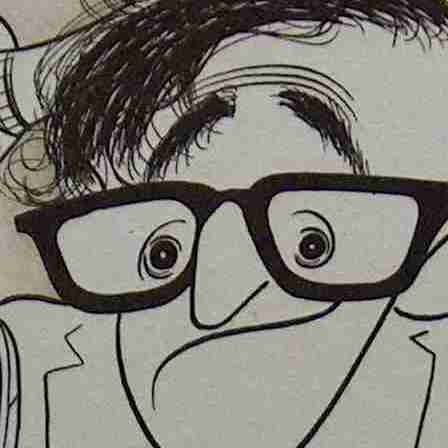
That quote, to me, encompasses Woody Allen’s wit, world view and his films. For me, he is the distinction between being ‘smart’ and being ‘intellectual’. Intellectual is being Ingmar Bergman. Smart is being Woody Allen. The main difference, for me, is not in the substance, but in the form. Both make you think – but while the smart can still be enjoyed at a lower level, the intellectual cannot be experienced without the thought. In more concrete terms, you can laugh at Woody Allen when he says, “To you, I’m an atheist; to God, I’m the Loyal Opposition,” without thinking too much about the larger implications of this line. Ingmar Bergman’s Persona, on the other hand, could seem like a series of inexplicable images if you leave your mind behind. The difference, therefore, lies in whether the person putting the idea forward is being direct about it or is shy to admit that he has a ‘message’.

When the Film Club at Law School screened Annie Hall as a part of the satire series, I was asked if it was one at all. It seems, at the surface, like a romantic comedy that was more intelligent than the rest that fit into that category. But just like most of his films, this is a brilliantly constructed satire on love, relationships and everything ("I thought of that old joke, y'know, the, this... this guy goes to a psychiatrist and says, "Doc, uh, my brother's crazy; he thinks he's a chicken." And, uh, the doctor says, "Well, why don't you turn him in?" The guy says, "I would, but I need the eggs." Well, I guess that's pretty much now how I feel about relationships; y'know, they're totally irrational, and crazy, and absurd, and... but, uh, I guess we keep goin' through it because, uh, most of us... need the eggs," he says at the end.) with his usual digs at Hollywood, the studios, the television shows and the meetings - a theme that he visits time and again in his movies. In Crimes and Misdemeanors, for instance, he tells his niece, "Show business is, is dog-eat-dog. It's worse than dog-eat-dog. It's dog-doesn't-return-other-dog's-phone-calls."

Two of his early films - Bananas and Love and Death - two movies that are not as nuanced or polished as Crimes and Misdemeanors or Everyone Says I Love You, but make you laugh just as much. Bananas is one brash, crass comedy in bad taste for the most part, but its general smartness keeps the movie going. It is not rated as highly as some of his other comedies for this reason, but does have genres of comedy that he seems to have grown out of - especially slapstick humour and silent comedy-esque sequences. The ridiculous plot involving Allen, a products tester from the US, becoming the leader of the tiny Republic of San Marcos in Latin America does not have the typical big set-up comedy sequences, but is filled with little throwaway lines, like his dig at the Vatican:

Nancy: Have you ever been to Denmark?
Fielding Mellish: I've been, yes... to the Vatican.
Nancy: The Vatican? The Vatican is in Rome.
Fielding Mellish: Well, they were doing so well in Rome that they opened one in Denmark.

Two sequences in the movie are amongst the funniest he has ever done - one when he tries buying the Orgasm magazine at a shop, and the other when he defends himself in Court. The sad thing about this movie is that unless one is a die-hard Woody Allen fan like myself, I find that nobody has even heard of it. It might not be even close to the best movie you'll ever watch, but it'll keep you laughing continuously for 85 minutes, without resorting to Borat-like toilet humour!
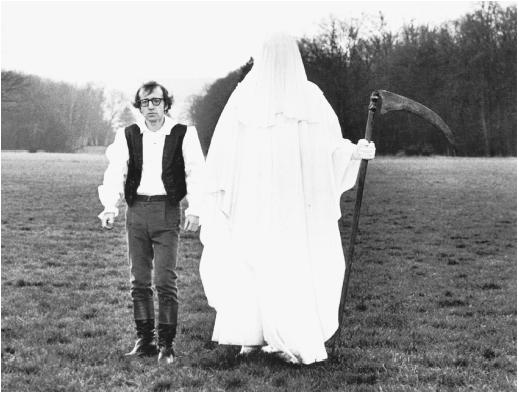
Another classic Woody Allen that is much-ignored by the world is Love and Death. This is probably because it comes just before his most famous movie, Annie Hall. Love and Death, for me, is equally good. It is his spoof, to use a crass term, on Russian Literature - especially the writing of Tolstoy and Dosteovsky. He takes another dig at Dostoevsky in Match Point in the scene where the guy has Crime and Punishment in one hand and a Guide to Crime and Punishment in the other hand. Love and Death is filled with references to Ingmar Berman's The Seventh Seal, especially in the last scene, when the credits roll, and Allen is following Death dancing behind him. There is also one joke about Persona, in the scene just before the end when Keaton and the other woman talk of wheat. In fact, the movie's most excellent joke is that scene where Allen is talking of various kinds of wheat and Keaton, standing next to him talks of the purpose of existence and love - just like in Russian literature.
Love and Death is Allen's transformation film, from farcical spoofs to very intelligent satires, and while the world will miss his physical humour that he executed so superbly in Bananas, Sleeper and Everything you always wanted to know about sex but were afraid to ask, the world will also be glad that he evolved into the King of Comedy - the King of Smart, Intelligent Comedy.

Smartness that is shown in his unique narrative style - all those scenes in his movies where time and space just don't seem to matter - like the one in Annie Hall when he visits his old house, and sees the party going on there, the one in Everybody Says I Love You where he dances under the bridge with Goldie Hawn and the sequence in Match Point where the two ghosts come and talk to the pratagonist about him killing them.

Smartness that is also shown in his one-liners, his sudden comment of deep philospophical significance that he dismisses a second later with a joke, and his ability to tear ideas and people apart - like the comparison of a TV producer to Mussolini and then a donkey in Crimes and Misdemeanors or his use of his stereotypical son to poke fun at metal-heads and his movie directed blind becoming a great success in France in Hollywood Ending. He does make a lot of fun of France in life - he once said, "For some reason I'm more appreciated in France than I am back home. The subtitles must be incredibly good."
The one thing, though that makes me laugh all the time, more than any one-liner, more than any scene in any movie, is the expression on his face and his reactions to people and things. In Crimes and Misdemeanors, when he is behind the camera listening to the subject of his documentary, the TV Producer, tell the audience how comedy is 'tragedy plus time', he makes this face of ridicule and disgust. Rishabh Gupta, watching the movie with me just the other day went, "Show me his face. Just once more. Please!"
***
Epilogue
The title of this post is borrowed from the title of Scorsese's movie starring Robert De Niro. Along with Woody Allen, Scorsese is my favourite director of all time. And along with Woody Allen again, and Jack Nicholson, Robert De Niro is my favourite actor of all time.

May 25, 2007

Mogambo Khush Hua!


When I read Rishabh's post on the best villains and bit-roles in movies, I thought that this list was a little Prince Harry (my latest term for anything white-man). This is my list - the desi counterpart. One must note that this list is biased in that I watch movies only in Hindi, Tamil and Telugu. In no particular order, here they are:

One: Paresh Rawal in Kshana Kshanam. Arguably Ram Gopal Varma's most fun movie ever, with pacy dialogue that would put a screwball comedy to shame, and a plot that compares with any acclaimed thriller, this blockbuster Telugu movie has lots of little characters excellently played - Paresh Rawal's sidekick who never has an answer to anything, and the guy who lives below Sridevi's house come to mind. But the one who takes the cake is Paresh Rawal, with his highly accented Telugu, his brilliant rendition of Ek Do Teen on the piano and the natural expression on his face that makes you laugh every time he's on screen! Given all this, in a couple of scenes, he does manage to be extremely menacing giving the movie its required thriller touch. If you haven't yet seen the movie, be dismissed from civilisation's presence, and come back when you have watched it!

Two: Rajat Kapoor in Monsoon Wedding deserves every accolade there is for playing a small role with extraordinary panache. Throughout the movie, you know there's something wrong with him, but nobody ever says anything. He doesn't say anything. But you still know there's something wrong. And that's where Kapoor scores. The expression on his face when he is asked to leave at the end is one of the images from Monsoon Wedding that will stay with me forever, because it is this expression that changes this really good movie into a great movie. (Also to be noted in this movie are Dubey and Alice - what a pair!)

Three: When people talk of Naayagan, they often shower praises on Kamal Haasan's role, the screenplay, the story, the direction, the music. While all these are brilliant and go a long way in making it one of Indian cinema's milestones, we often ignore the smaller contributions that hold this classic together. Janakaraj in his little role as the Godfather's right-hand man is at once the humble, serving, caring aide and at the end, the only companion of Velu Naayagan. But in this one scene in the courtyard, when Velu's daughter slaps him, his reaction is sublime. His role in Roja was in serious contention for this spot, but when I remembered this scene, we had a clear winner. Janakaraj is definitely one of Tamil cinema's much-ignored dynamites - capable of handling slapstick comedy and drama with such dexterity, and yet merge with the background, not ever wanting the limelight for his work.

Four: This is a joint position awarded to Saif Ali Khan and Dinesh Dobriyal for Omkara. Jointly because I didn't want to give two awards to the same movie, and I the scenes I enjoyed in the movie the most were scenes involving both of them. Most notably, the one on the bridge. And, the one on the terrace where Dobriyal announces to the world, "Langda Tyagi, Bahubali! Bahubali, Langda Tyagi!" Other memorable scenes involving these two in this memorable memorable movie are the scene where Saif breaks the mirror, the scene where Dobriyal speaks on the phone to Billo, when Saif shoves the invitation cards in Dobriyal's face and asks him to distribute, and the end when Saif declares that there is no difference between his truth and lies anymore. Langda Tyagi, movie should have been named after you, and not the Company-redux Omkara!

Five: Gabbar Singh. I shall not say more, for there is nothing left to be said. Watch Sholay if you haven't, and you'll realise, no words can do justice to Gabbar! Man, that lecherous expression he has in Mehbooba...

I put this in a separate paragraph because I think Gabbar Singh can't share the same space with anyone else, but check out a similar villain in Chinagate. He's damn good too.


Six: Gangu Thai from Waisa Bhi Hota Hai Part II is the most disgusting, scary, vulgar, ruthless and for those very reasons, funny villain Bollywood has ever produced. In one of the most under-rated movies of this decade, filled with brilliant performances by everyone from Arshad Warsi to the Balle Balle Boys, two people stand out - the guy who played Vishnu, and Gangu Thai. Because we're going with the smaller roles, I leave Vishnu out. Gangu Thai delivers her dialogues in that over-the-top, Chhammiya No. 5 style, and makes you believe in one scene that she is actually capable of cutting one of her men's fingers. When Arshad Warsi calls her, "Maa!" you really see the love she has for her 'son'. She makes you cringe, cry, put off the TV, fast forward, and at the same time, laugh, love, and revisit her role in this quirky, farcical, one-of-a-kind movie.

Seven: Kannathil Muthamittal is right up there amongst Mani Ratnam's best. It is a celebration of unabashed senti-ness, and is executed brilliantly. Nandita Das has a total screen time of about 20 minutes in a two and a half hour long movie, but along with Keerthana, she is the subject of the movie. In those twenty minutes, she manages to create such an impact - first, as the carefree wife, then as the refugee, then in that LTTE camp as a cold-blooded freedom fighter, and in that last scene, finally, as a mother. A close second as Tamil cinema's best amma role (Nandita Das was not really a traditional Nirupa Roy style 'amma' role, but she was the 'mother', so that counts) is Srividya in Thalapathi. The scene in which Rajnikanth and Srividya react to the sound of the train - only Mani Ratnam could have conveyed so much so subtly, and only Srividya could pull it off on screen.

Eight: This entry might be a little biased because I think Simran is a goddess. However, in Pithamagan, in the ten minutes she appears on screen as herself, she is just unbelievable! The scene involving Simran is so audacious, that it could have either gone down as a publicity stunt, or as one Tamil cinema's most famous scenes ever. Simran, with some help from the absolutely electric Surya, and a superb Vikram, makes sure it takes the latter route. The energy and the joy that fills this sequence is unmatched by anything I have ever seen on screen!

Nine: When I spoke of Paresh Rawal in Kshana Kshanam, I mentioned how the natural expression on his face just made you laugh every time you looked at him. Its the same quality about Om Prakash that puts him one level above the other stalwarts acting in Chupke Chupke. In that movie, Dharmendra and Amitabh have all the punch lines, Jaya Bachchan does the pretty-looking routine, Sharmila Tagore is the one who sings the songs, but Om Prakash as the soap-selling, retired-barrister, genius jijaji steals the show.

Ten: Lastly, I salute one of India's most famous villains ever - Mogambo. Amrish Puri, over the years, has played all kinds of roles - the London-settled desi at heart, ridiculous villains in crazy outfits (Telugu movie watchers will remember Jagadeka Veerudu Atiloka Sundari and Atavi Donga), the evil zamindar, comic relief and so on. But, for twelve whole years of my life, every time I saw him on TV, I'd say, "Mogambo Khush Hua! Eehahahahaha!" Along with Gabbar Singh, Mogambo is Bollywood's most recognised, parodied, imitated villain ever, and in my books, given Sholay was before my time, a villain with whom I share a special bond, for he was the first bad-guy I loved!

May 10, 2007

What's in a Name?

Thanks to Woody Allen and Rushdie for some 'inspiration'.

"You know, there are some books and movies that I cant bring myself to watch simply because of their names?"
"What bullshit!"
"No. Seriously. If someone told me, 'Go watch Waisa Bhi Hota Hai Part II, its really good,' I'd stop trusting his movie tastes immediately, even without watching the movie."

I backhanded another dosa on the tava as I listened to this conversation in the background. Of course I understood the feeling, having a bias against something because you don't like its name. I have suffered from it for twenty-one-and-a-half years myself. My name is Mona Lisa Devi. Yes, I am serious. That is my name. Apparently, when the news of my mother's pregnancy reached my father, he had just come back from seeing the Mona Lisa at the Louvre, and was awestruck by its beauty. I shudder to think what my name would have been if he liked Da Vinci's Virgin of the Rocks instead! My mother, on the other hand, promised various Goddesses that she'd name me after them if I turned out to be a girl and because she couldn't have given me thirty names, she named me the generic Devi. And so, there I was. Their proudest possession, Mona Lisa Devi.

For years I tolerated things like, "Smile, Mona Lisa... Oops, I forgot. No one really knows if you can smile or not." Laughter all around. Or the "Mona Darling..." in that typical Ajit voice. Even more laughter. Every time someone saw my name in an application form, I'm sure a little remark would be made, "And I thought Blossom Babykutty was the worst I would come across" or, "Why would you do that to your kid?" or, "Lets give her an admission just for the name!" The Bombay Vikings song "O Mere Mona Re" allowed society to attack me with renewed vigour. Cheap, lecherous men on roads who earlier stuck to their usual set of lines that had rehearsed for the other women now had a song to sing.

It's not as if I had never considered changing my name, but just that I thought of it a little late, and although I never learnt to ignore the ignominy I suffered, I learnt to tolerate it, albeit with the ocassional, "Give it a break!" or, "You know, a kid in my kindergarten class cracked the same joke," or on some particularly bad day, "I curse you, bastard. I wish your telephone number is one digit away from an all night taxi service!"

The dosa had now become a crispy brown, with the oil making its presence felt, without being overbearing. The chutney and molagai podi made it perfect for a light 'tiffin' dinner. I walked back to the drawing room where the conversation had now moved to the Teenage Mutant Ninja Turtles. I remember loving the Turtles because there was this obscure character called Mona Lisa who appeared in one episode. For years, this little salamander-like animation series character was my lease of life. I knew that what I had was a real name. A really bad one, but a real one nonetheless. I sometimes wished I got hold of some mutagent, so that I'd become like that Mona Lisa, and spend my time with people who didn't hold back a sly smirk every time my name was uttered.

As I drifted into the world of the Turtles, slowly devouring the round dosa, I heard one of them say, "I'm going to Delhi this month for three months, and I need one of you to stay at my place. " I jumped on the opportunity. I had gotten tired of my roommate, and this crummy apartment.

My friend, Ananya Rajan, lived in the opposite end of town, and for those three months when she was away, I lived her life. I ordered pizza. When the guy asked me for my name, I didn't have to hear the customary, "Mona Lisa? Did I get you right?" Instead, I heard, "Yes, Ms. Ananya. Would you like extra cheese?" When I bumped into this cute guy in the corridor of the building, and he asked me who I was, there was no, "Oh, Mona Lisa... Um, yeah. Um, have a nice day." He said instead, "Ananya? Flat 203? I always wondered what you would look like." At least for the time that I spent in the building, I was Ananya - the lovely girl with the lovely name.

And one evening, when the Cute Guy and I were watching TV at home, I heard this knock on the door. There was something about the quality of the knock that made it sound cruel. And clearly, the knocker was in a hurry, because even before this knockee could get to the door, the knock had repeated itself four times. When I opened the door, I had this strange feeling that I wasn't opening the door of my house, but the door leading to some dark, evil land. At the door stood this tall figure in a black hood carrying a weapon.

"Ananya Rajan?" he asked, in his rough voice.
"Yes..."
"I have come for you."
"Who are you?"
"I am Death."
"Oh, there's been a mistake. I'm not Ananya Rajan."
"That's what they all say. Your night shirt has AR stitched on it."
I was wearing her clothes! "No, I'm serious. I'm Mona Lisa Devi"
"You expect me to believe that?" he said, with an evil little grin.
Then Cute Guy came to the door and said, "Ananya, what's wrong?"
"Stop calling me that!!! I AM NOT ANANYA!"
Death laughed louder and louder, and the world dissolved into nothingness.

When I got up, this nurse told me, "The operation is successful. You'll take some time getting used to those wings. Here, take this. This is the latest model," handing me a harp. Then, shouting out to someone, she said, "Mona! There's another one of you now. You can stop crying now," and turning to me she said, "She's been crying here for five hundred years. She hates her name, you see."

May 7, 2007

Five Most Bizarre Movie Watching Experiences

At number five, we have Miss Congeniality 2. My third year in Law School. At Symphony. The third movie I saw in a theatre other than Cauvery in Bangalore (the only other ones being Love Actually, and American Pie at Plaza). This was after one of Siddhartha "Bojaj" Sen's mega-lunches - the one to which he invites all his non-Bong buddies - the most sumptuous free meal available in Bangalore. Only, it isn't always "available", and you have to be on the good side of Bojaj for a considerable amount of time. But given that, trust me, it is worth it. So, after this lunch, we (being around 25 people from our batch) proceed to Symphony, at Apurva's insistence to watch Miss Congeniality 2.

The plot involves the kidnapping of Miss USA - some actress who looks like Miss Palampur in the Cadbury ad, and Sandra Bullock wavering between a reluctant bimbo and an FBI agent who wants to recover the lost Miss USA. It was the experience of the movie that is memorable though - I was really full, and desperately wanted to "release" (in Shankara's words) and then have a short (read five hour) power nap. Unfortunately, this movie was filled with shrieky women who shrieked even louder just when I dozed off. Or so I thought. Apparently, I did sleep really well, because at the interval, when I asked Apurva, "You like what you've put us through?" she said, "There was one good joke about euthanasia, come on." I had aboslutely no recollection of any such joke!
It also has the worst last line in movie history - some joke about World peace. I have never been gladder when I walked out of the cinema hall!

Coming in at number four, is Mungaaru Male, the recent Kannada smash hit that has been running in Bangalore for over four months now. And so, after years of staying away from latest Kannada movies, myself and phamily decide to go the Alankar Talkies (pronounced tyack.iss) in Udupi to watch this movie. Appa, I have believed for years, is the Godfather of Manipal. When he walked into the office at Alankar to pick up tickets, the three people sitting there in serious conversation all stood up to welcome him. The owner summarily dismissed his other guests and seated us all in his little office. Then, he gave us the tickets, and seated us in the best seats in the theatre, and served us juice! The last time I had gone to Alankar was eons ago to watch Jurassic Park in Hindi, a little before Diana Theatre released it in English, but way after I had seen it in Bioscope (the little illegal video hall) in English. (The one other movie I watched in Bioscope is Chinese Kaamasutra bunking non-detailed English class.)

I will remember Mungaaru Male forever for two reasons - for that one astounding shot of Jog Falls (no sarcasm here) from the mouth of the Falls looking downwards, and the ending - with the rabbit being buried.
Plot Summary
"Inky Pinky Ponky.
Man had a rabbit.
Man cried.
Rabbit died.
Inky Pinky Ponky."
The rest of the story is, really, some sort of a, irrevant. Kannada cinema's fascination with the rabbit continues. In America, America, the heroine owned a pet rabbit, leading to the movie's most chilling scene where everyone suddenly thinks the rabbit has been put in a pressure cooker. Here though, the rabbit irritated me to the extent that I almost did a little celebratory jig when it died at the end. I wish the heroine died a little earlier. I couldn't stand to watch her fill the screen for much longer. For a description of her face, take the Tamil expression "Lakshanamaa irkaa" and imagine the exact opposite. "Crank Call" Ganesh was fine until he got drunk and started crying. The rest of Kannada cinema must be astonishing junk for this to be the industry's biggest hit. Still, I must admit, I was entertained for the two and a half hours, and never wanted to leave the hall!

For a better version of rabbits dying check this out.

Third Place goes to The Adventures of Shark Boy and Lava Girl - watched this March in East Marredpally, Secunderabad with little cousins. I sometimes wonder why I subject myself to these things. However, I had strong reasons for watching this one. When the opening credits came, I saw that the director was Robert Rodriguez (remember Sin City?) and resumed that this couldn't be too bad. How wrong I was.
Three years ago, I watched Aditya Verma act as an alien in a play. The bizarreness of that play pales in comparison to Shark Boy and Lava Girl. Firstly, the boy is a boy who is also a shark, and the girl is Lava. They have nothing in common. Also, they don't exist. Or, do they? Even if they do, what are they? There's this moment of discovery towards the end, when they each realise they are actually the King of the Ocean and Lady Light! I presumed they were in some guy's dream, but they appear at the end to save his parents. In reality. There is also evil kid (whose name I've forgotten) and Electric Man and the Ice Princess, who wears a magic necklace. The special effects could have given Shaktimaan a run for his money, and the acting could have put the clueless Senura in Scenes from Pulp Fiction to shame! Yet, a must-watch for sheer trippiness.

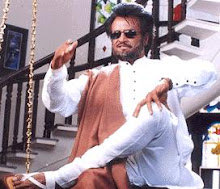
The runner-up in this contest is Baadsha at a random little theatre in Moodalpalya nearly ten years after it was released. Nobody can match Thalaivar for sheer style, and no other collection of people can match Thalaivar's fans for sheer enthusiasm. Everytime he said, "Intha Badsha oru darava sonna, nooru darava snna maadri", the small crowd went ballistic. Every song was cheered and danced to. Thalaivar was encouraged in every fight sequence, "Avanai nanni adinga, Saar". Every entrance of Nagma was met with crass hooting. When Rajni was tied to the pole and beaten up, I could almost feel the audience seething with rage.

The movie itself is one of my favourite Thalaivar movies. It mixes his big set-up scenes with little throwaway lines that are brimming with the most profound of thoughts. He mixes style with humility. He doesn't hesitate to talk directly to his audience, and almost single-handedly turns what would have been a mediocre pot-boiler into the movie that spurred the auto-drivers self determination movement!

The Winner, by a few light-years, is Jai Vikraanta. One night in Bombay, Parashar, Singla and myself, being the insomniacs that we are, were flipping channels at Q's place. Now, when we reach Sab TV, there's this police officer, whose name we later find out is Sher Khan, is holding a gun to this foreigner saying, "Drugs bhejke desh ke naujawaanon ke jeevan barbaad karnewaale haraamzaade!" The foreigner is called Christo. He is then taken to the police station, where in the lock-up is an old man, who has just delivered a monologue of having been in prison for years. Christo sees the man and tells the police, "Yeh hamaara gang mein shamil nahi hai, " and benevolent Shar Khan says, "Christo ke bayaan pe mein tumhe chhod deta hoon." If only the Criminal Procedure Code was this simple!

For almost two hours of the movie, the three of us laughed non-stop. What with people calling each other, "Raja Harishchandra ke aulaat!" and wearing knitted sweaters with cats stitched on them, and a long-haired Sanjay Dutt as the Robin Hood-like Vikraanta prancing around on horses with his little band of outlaws. Apart from the initial exchange that we watched, two little incidents in the movie stand out - first, when Sher Khan says, "Christo bhaag gaya!" Parashar literally fell off the bed! Second, when Q came in and did the voices for this ridiculous scene where the heroine holds Vikraanta's sword and dwars blood from her hands and applies it on his forehead. Heroine is holding the sword in her hand, Q says, "Is your member as long as this?" She wields it around. "Is it this flexible?" Then she runs her finger along its edge and draws blood, "I don't want to talk about this!"

May 3, 2007

The Reluctant Genius

Four years ago, I found myself drifting away from Carnatic music - Law School's reinforcement of popular music perpetrated through the mp3 sharing culture, and the need to not feel left out when people were discussing the latest Audioslave album, or some obscure Beatles' song had an indelible impact on my musical tastes. Although I still listen to Audioslave and The Beatles, one little incident brought Carnatic music right back into the top spot. While looking through Periamma's vast music collection, I came across this cassette that had T.R.Mahalingam printed on it (with a typewriter, presumably) - one of those recorded cassettes, neatly labelled in her years in the US. Having heard a lot about Mali, from my grandmother, but never having ever heard him play, I decided to listen to that cassette, even though there was this Jimi Hendrix CD waiting to be explored.

Wafting through the speakers of the little Phillips cassette player was the most quaint and extraordinary Sankarabharanam I had ever experienced. Each phrase was distinctly Sankarabharanam, but was still nothing like I had ever heard anywhere. His shrill flute produced a sound that was stamped with his unmatched genius, without seemingly stretching the boundaries of the raga. The alapanas were punctuated by long pauses, almost as if he was giving you time to digest what you just heard. And just when I thought I might never hear anything that beautiful, he started Kapi. Weaving the entire alapana around one or two notes and recurring phrases, he played a Kapi, the likes of which I have never heard again in my life, except in two other recordings, each of them approaching the raga from a different perspective. When he meandered in the mandhra sthayi in another recording of Kalyani, I felt the whole world dissolving into a mass of irrelevance. Nothing seemed worthwhile anymore.

Suddenly, I was obsessed. Like an alcoholic who couldn't go a day without alcohol, I needed Mali's music to keep me sane. Unfortunately, the more I learned about his life, the more disappointed I became. Being a reluctant performer, which according to a biography was a result of the exploitation of his talent by his family in the early years, he recorded very little. When he was older, he took to the bottle, made fewer and fewer public appearances, claimed that he suffered from this recurring 'headache' that caused his mind to go blank, and didn't turn up on days when his concerts were scheduled.

Today, Mali's music exists to my generation in a few studio recordings, and one live concert recording that I have come across. But to those who have listened to his concerts, I can see their eyes moisten when they talk of his version of Begada, or Hamsanaadam, or those little folk tunes that he used to play towards the end of his concerts. For many 'rasikas', as we are referred to, he will remain the greatest instrumentalist ever - Miles Davis,
Hendrix, Coltrane, Zakir Hussain can all make way for this little known King.