Nov 5, 2007

Not an Interview With The Milkman

I usually don't like allowing guest bloggers on this blog, but Xebo's been asking for a while - he interviewed me sometime ago, and doesn't have any other place to publish the interview, because, frankly, no one wants to read it. For the uninitiated, Xebo has been my closest imaginary friend ever since I can remember myself. He is my staunchest critic, a nasty, unemployed, no-gooder ... Okay, he's not letting me finish that sentence. So, over to him.
***

Xebo: Good day, readers. Today, we have with us a special guest...
Me: Cut to the chase, da.
X: I recently read a report from a psychologist who claims that you are sexually (CENSORED)... and that is why you claim that you do not watch pornography.
M: I'm sorry, I don't want to discuss that report. And I do not watch pornography on moral grounds.
X: Sex is immoral?
M: Sex with milkmen, or on islands definitely is... Especially when you're running a temperature.
X: Are you evading these questions because you agree with the contents of the report, and you do not want them to be disclosed?
M: No comment.
X: Your first interview, and the celebrity lingo is already in place! (Smiles all around) Another report from a close friend reveals that the name...
M: Whoa! NO! NO COMMENT. NO COMMENT.
X: What are your opinions on the question of whether Rama built the bridge?
M: The matter is sub judice, and I wouldn't wish to comment on the same.
X: What can you comment on?
M: Um, the weather?
X: The weather... Yes. Um, I was at your convocation recently, when you were told of the dangers of climate change. You must today be proud that a Nobel Laureate, Dr. Pachauri, was the Chief Guest at your Convocation.
M: That I will never be. I mean, he gave the most depressing speech in history, I didn't see the point of my degree - what use is the degree if we will all die in twenty years?
X: Seriously, you should crack a new joke once in a while - it has been two months, and you crack that one at least once a day!
M: To different people. Nobody's heard that twice.
X: I have.
M: Not my fault that you're always around!
X: Are there any other jokes that you keep repeating?
M: What is the characteristic or attribute of being a lock?
X: That's not even an original joke.
M: Anu Malik said, "Nothing is orginal, everything is inspired."
X: You say that all the time too. In fact, this is a trend. You have some five jokes in your life, and you repeat them at every given opportunity. For instance, let me cite two instances from this blog. In Love Brinjal - Part I, you say "In an interview, Vishwanathan Anand said that no two women can make the same rasam. They might have learnt from the same person and follow the same recipe, but the rasam is never the same." And then, in your Untitled bullshit story, "...on how no two South Indian women can make the same rasam even if they follow the same recipe..."
M: The contexts are very different, lending the jokes their diverse nature.
X: Elaborate.
M: Um...
X: Fucked you.
M: I was just formulating the right response. The thing is, in one case, I am talking of Vishwanathan Anand, and in another case, it is of an old grandfather. It shows how opinions transcend generations. Basically, history is circular. So is morphology. Haven't you read Circularity of History by Bazouki?
X: Apart from the fact that no such book or author exist, I love the way you use names and titles to defend your opinions. You're such a wannabe academic!
M: Academic, I might be. But wannabe?!
X: Then why do you watch movies you don't understand?
M: I understand the movies I watch. Want me to write a review of Persona?
X: Stop getting defensive. I didn't even mention Persona. I've always thought that you overrate many things just because names are attached to them. You're dying to be counted amongst the cool.
M: That's such bullshit. Just because I slept off while watching 2001 for the first time...
X: You're giving all the right examples.
M: Pah!
X: Tell me the name of the last book you read in entirety. In Entirety.
M: Klingsor's Last Summer, ha.
X: Damn. I was hoping you'd mention that other book you gave up midway - I'm sure you'll claim to have read it to everyone.
M: I never do that.
X: Shame?
M: Shame?
X: Rushdie - Shame.
M: I skipped one chapter in the middle. One chapter.
X: And two at the end, and one more somewhere else maybe.
M: It doesn't have that many chapters.
X: Exactly my point - you hardly read any of the book. Getting back to coolness value - I think that is the reason why you're reading that Adam Smith book now.
M:
That is so untrue.
X: I mean you dont even follow what you're reading most of the time - you just stare at the page and look intelligent. Just like you do when you download and read articles on the World Bank.
M: Oh, those I read only for effect.
X: You're whole life is only for effect.
M: Maybe...
X: Oh, we're almost running out of time. Thank you for that candid interview. I hope to having you on this show again later.
M: Not on my blog!!
***
And therefore, no guest blogger shall be allowed on this blog!
___

Nov 4, 2007

V for Venkatesh

There was a time in my life when it wasn't K for Karan Johar. There was a time when the alphabet K had nothing to do with mother-in-laws and daughter-in-laws fighting to gain control over the kitchen. Because K was for Kshana Kshanam. And V for Victory. V for Venkatesh. There was a time when every self-respecting Telugu filmgoer muttered "Devuda, devuda..." under his breath at times of pressure. There was a time when, "Nenokka donga," (I am a thief) was a fashion statement, and wearing flower shirts with jeans with the top two buttons open was a way of life.

That was the time when Ram Gopal Varma made stunning crime thrillers laced with intrigue and adventure, and had one-liners to kill for. Truly sad that his last four films as director have been Darling, Ram Gopal Varma ki Aag, Nishabd and Darna Zaroori Hai. Ah, digressions from the main topic.

This morning, driving back from the airport, a dull radio announcer on AIR FM Rainbow, who sounded like a college professor on sedatives giving the same lecture for the hundredth time, said "Ko ante Koti!" (equivalent of 'C for Crore'). My heart missed a beat, I went up one gear and increased the volume. Sure enough, Sridevi's slightly off-tune voice sang, "Kingula Kanipistunnadu..."

I was taken back to those times - when V was for Venkatesh, and K was for Kshana Kshanam and Ko was for Koti.

Kshana Kshanam, about a bank employee (Sridevi) who accidentally comes in possession of one crore rupees robbed from a bank and a petty thief (Venkatesh) running away evading the cops and the robbers, is a masterpiece. Venkatesh is stunning as the thief (Chandu, I think his name was), and Sridevi was even better as Satya and the two together rival the greatest screen chemistries in all cinema. For years after watching KK, I wanted to get stuck in a forest with a girl. (I did also, once, but that wasn't really a forest, and we weren't really stuck.)

For years after that, Venkatesh remained my favourite actor, and I watched Sahasa Veerudu Sagara Kanya, Anari, Super Police (which had music by A.R.Rahman - and along with Gang Master, it was Rahman's only two Telugu movies to date) when V started standing for Vidhu Vinod Chopra, and K for Kuch Kuch Hota Hai. Many years later, I did watch Malleswari starring Venky opposite Katrina Kaif, and I noted that he had lost none of his original timing or delivery. "No caste feelings," is amongst my favourite lines in Telugu cinema.

But there was a time, when cops, robbers, railway cloak rooms, tribal songs in the forest and a chilling Paresh Rawal created one of the best movies of all time!

"Tandatarara. Tandatararaaa. Tandatarara..."

Oct 29, 2007

Two and a Half

If I didn’t respect Fellini as much as I do, I might have made a movie called 2½. No, it wouldn’t concern a harried movie director – it would be about my 2½ sruti, eight holed, bamboo flute – my mistress for the last two years, one who misbehaves when treated badly!

This flute has remained faithful through all my phases – from the time when getting a sound out of it was an achievement, to those days when hours of repetitive scales ensued to today when ragas and kritis attempt to emanate. It has been there through my extended Hamsanaadam phase, my brief love affairs with Nalinakanti, Harikambhoji and Kapi, and my sorry attempts at Mukhari and Saveri – helping me along, giving me ideas, and showing me quirky phrases. It does, although, act up. There are days when the lower octaves are unattainable, and other days when higher octaves sound too shrill and screaming. There are days when the music is punctuated by occasional, inexplicable screeches and unwanted, deep baritones.

I know that in some years, this 2½ will be replaced by a better, uncracked, heavier one providing a richer tone and better handling, but for the rest of my life, this 2½ will remain my most treasured one – because it is not only the first flute I ever bought, it is also that flute with which I terrorized the hostel for two years, and the flute with which I first played on stage.

Oct 23, 2007

Worthy Living

In a famous scene in Manhattan (1979), Woody Allen says:


"Why is life worth living? It's a very good question. Um... Well, There are certain things I guess that make it worthwhile. uh... Like what... okay... um... For me, uh... ooh... I would say... what, Groucho Marx, to name one thing... uh... um... and Wilie Mays... and um... the 2nd movement of the Jupiter Symphony... and um... Louis Armstrong, recording of Potato Head Blues... um... Swedish movies, naturally... Sentimental Education by Flaubert... uh... Marlon Brando, Frank Sinatra... um... those incredible Apples and Pears by Cezanne... uh... the crabs at Sam Wo's... uh... Tracy's face... "
What would I say?

"Why is life worth living? It's a very good question. Um... Well, There are certain things I guess that make it worthwhile. For me, um... definitely Woody Allen... and um, mathematics... Mali's Shankarabharanam, um... Ooh - Swami and Friends by RK Narayan... Um, Brian Lara's batting obviously... Swedish movies, naturally... diluted beer at Pecos, A.R.Rahman, Sanjay Subamanian live..."
What would you say?

An update: Disktop has just reminded me of good sweet milky tea. That gets duly added to this list!

Oct 17, 2007

Understanding Modern Poetry

Today, we shall study Modern Poetry and its semantics through the interpretation of one of its most famous pieces, Frei De Fisch's Freedom from Early Morning Phlegm.

(The poem is reproduced below for reference.)

***
FREEDOM FROM EARLY MORNING PHLEGM

Nose.
Earmouth.
eyeeyelasheyelideyewash. eye-o.
Yeehaw!!

Bloody bloodsucking swishing swordfighters learnt lapdancing.
Ernest Hemingway wrote, "Yeehaw!!".when will my pretty mama come to me?
before MaMa, i come home?
Yesterday's sufferers are Today's
Underwriters; Underwear understands underlying underlings' under underrated undervaluation.
Yeh under ki baat hai.

Ali Bhai is a Spy.
Sometimes, I look back pregnantly at poignancy and wonder Why?
Old Sailor told Gifted Sundararajan Ramanamoorthy not to cry.
Why?
Yeh under ki baat hai.
Feel fuckin free. FREE!


go
away
today
no?
***

Rhyme and Meter: Few people know, that as a kid, Fisch had this disorder by which he would stress on every third syllable, and to get the inner meaning and rhythm in his poetry, it is essential to stress on every third syllable. It is also rumoured that at the time when Fisch wrote this poem about his traumatic early morning experiences, the Enter key on his keyboard was malfunctioning, giving the poem its broken structure. In an interview, shortly before his accidental demise, Fisch said, "My life mirrors my Enter key. Often, just like the key, I feel pressed."

This poem's third verse is Fisch's tribute to the early years of poetry, when rhyme was considered important. Fisch always maintained, however, that although life is poetry, life doesn't rhyme.

Understanding the Poem: Most Modern poetry, is freewheeling, inward looking and unbound - it does not answer questions, but asks questions of you. Early Modern Poetry, however, has a verse that lays down the broad framework within which the poem will operate. In this poem, the first verse tells you that the main theme of the poem will be the nose - a recurring theme in Frei's work (Frei always thought that his nose was too pointed and often worried that he might injure someone with it.) - and the rest of the verse tells you that it will also involve the ear, the mouth and various parts of the eye.

Crucially, the poem will deal with a problem and a solution - characterised by the exclamations, "eye-o" (Frei's crude transliteration of the Tamilian, "Aiyo!") and "Yeehaw!!"

Note Frei's characteristic style of pairs of words strung together to form a sentence in the first line of the second verse. This line is an empty signifier - it means nothing, and shows that life starts with a sense of nothingness. And then figured start populating it - like Ernest Hemingway, whom Frei shared a close relationship with. He often dreamt of Hemingway as an employee of the Income Tax Department chasing Frei around Portugal's farmlands in a Samurai outfit, screaming, "Yeehaw!!"

After the men, come the women, and lastly, Ozzy Ozzbourne. This poem is set in the time when Ozzy was Frei's greatest inspiration. Photographs of Frei's house with a painting of Ozzy standing like Jesus Christ are widely available on the internet. And while Frei suffered in those days not being able to tell the difference between his obsession and his religion, he took up a job at a company that engaged in underwriting.

His work brought him to India, where the famous ad for Lux underwear led to the landmark trademark decision of the Supreme Court of India on the word "under" - that similarly pronounced words in different languages having similar import in certain circumstances could be used interchangeably. Frei takes a dig at the Supreme Court's undervaluation of the damages in that suit.

This was around the time when Frei met his closest friend, and later greatest enemy, Ali Bhai. Ali Bhai had a running nose for most of his life, and their close association led to Frei contracting the same problem. Ali Bhai alleged, being high on Himesh Reshammiya's music, that Frei had contracted this from Ali's wife. Frei then accused Ali of spying on his bedroom and never spoke to him again.

Just like Gregory David Roberts, Frei was given an Indian name - Sundararajan Ramanamoorthy. Frei's prose consists of only one book - Sundararajan - that sold only three copies - all bought by The Frei Memorial Library in Portgual. Frei often refers to his publisher, Penguin, as an Old Sailor in his poems. The reasons are unknown.

The last verse of this poem, say some Frei scholars was a printing error that crept into only the later versions of his noted collection of poems - Fourteen Feathers and a Football.

Oct 10, 2007

Early Morning Cold Taxi

At 5.30 am, when many of my buddies were tottering into bed after pondering through the night over what Hecksher and Ohlin were on, Arun and I woke up to accomplish the same task. We staggered into the corridor, feeling that familiar-September feeling, of having holidays and festivals round the corner, and sang, almost together, "Early Morning Cold Taxi" in the same tuneless monotone.

"Dude, WHAT is this song?" I asked. I had been singing this same line - actually, it was more like poetry recital - for two whole days without knowing what it was, what it meant, or where I had heard it.
"Dementor keeps singing this..."

When he got up for that day, we asked him, "Dude, play us this song..."
And he did. For the rest of the year, Dement insisted that there was one place where The Who sang this tunelessly. Nevertheless, we were hooked - to Early Morning Cold Taxi, and to Dement.

And before every exam, till he end of my fifth year, if I felt unsure or jittery, I'd sing to myself,


3:36, it's cold, I know I'm growing old,
With life's best side on the downward slope,
It's in my own hands, I know I'll cope,
My girl's with me and all my friends can see.

Here I am again,
Early morning cold taxi.
At every Western Music, the three of us would briefly contemplate singing Early Morning Cold Taxi - branded our room song (one that changed to Grab your balls like Michael Jackson when Geek moved in) - and Al would chicken out.

Singing was the only thing that I had even seen Al chicken out of - he took on Lizzy and her bouts of madness, ESPN-Star and it's hiring policies (when he went up to their office in Singapore and demanded that he be taken in as a commentator), much bigger opponents from Al-Ameen in every football match, and Jian Johnson's might in that last basketball game. All with the same passion, intensity and earnestness.

In his own words, "I can't stay quiet in the face of injustice."
***

Al was also the source of endless entertainment and conflict in our room. In the run up to the 2003 World Cup, Arun and I decided that we had to make that trip to South Africa. And like all reasonable persons, we realised that the easiest way to do that would be through the "Britannia Khao, World Cup Jao" scheme. And like good boys who didn't overspend, we bought one pack of biscuits a day, and religiously saved the wrappers. When we had enough points to be eligible for the trip to the World Cup, we rushed back to the room to pick up the other wrappers and claim the hallowed Scratch Card.

When we reached the room, we found it spotlessly clean - even my extra-messy cubicle was swept and swabbed, the clothes were all folded and kept in the cupboard, and the wrappers were missing. Al had cleaned up our room, and cringed at the fact that his two roommates ate these cream biscuits everyday, and had not even bothered to throw away the wrappers. We didn't talk to Al for two whole days.

And his response was typically Al, "You guys don't love me."

We do, Al. And we always did.
***

There are so many enduring things, incidents and quirks about Al - like how he used to study really hard way before the exam, and potter around on the day before it, and go for a long run or jump and try hit the ceiling. Like how he was mortified of frogs. Like how he

I shall be eternally grateful to Al for one thing - teaching me how to play FIFA. I used to play FIFA even before I met Al, but he was the one who taught me how to play FIFA. And when I'd play for a little too long on his computer at night, and moan and curse loudly while he tried to get some sleep, he'd always tell me, "Mami man, hump off."

Once more, Al, just ask me to 'hump off', and I'll stop playing FIFA forever.
***

"
This world was never meant for one as beautiful as you."
- Don McLean

Oct 4, 2007

The Curse

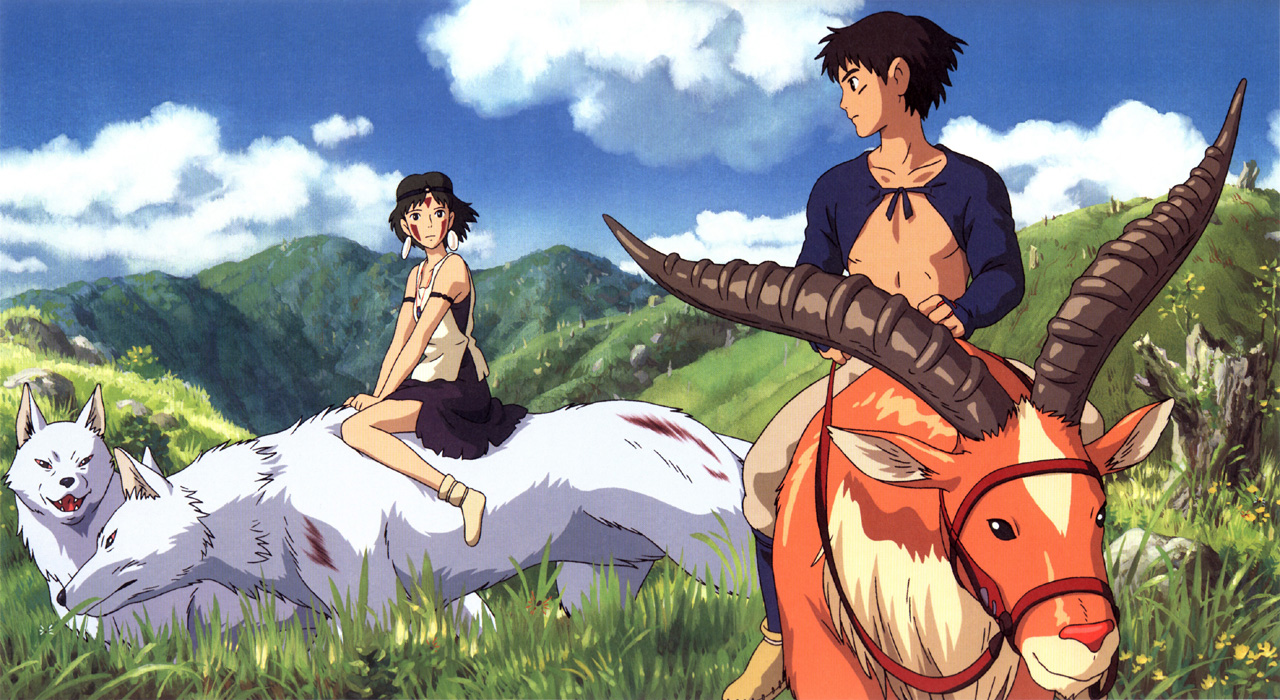
Before I gave my laptop away (in exchange for a new one that is still on its way), I watched some scenes from Princess Mononoke, arguably the greatest animation film ever. (Do I hear a voice in my head asking me about Grave of the Fireflies?) Although I have been promised that all the stuff on my hard disk will remain on it, I am a little apprehensive - I fear I may never be able watch Princess Mononoke again. Princess Mononoke is a masterpiece - an achievement in animation, a hand-drawn full length animation film that rivals most computer-animated material, making up for what is lost without the computer with painterly richness.

Grave of the Fireflies has powerful images - perhaps not as beautiful as the image of Prince Ashitaka on his stag riding along the mountain, but so powerful that it makes you cry. Grave of the Fireflies touches you somehow, it makes you want to cry. It evokes nostalgia even though we haven't gone through anything even remotely similar to the experiences of the two children post the Hiroshima bombing.

Princess Mononoke does other things - it asks you questions of yourself and the way you live. It works in different layers as a spellbinding narrative and a big metaphor at the same time. It is contemporary and yet fantasy, it is unreal and yet real. Princess Mononoke tells you something about people - that there aren't good people and bad people, and that everybody has a reason for everything they do. And when the reasons are as strong as they are in this movie, you realise you have a tough time deciding who the villain in the movie is.

This post did not start off being about which is the better movie, or why Princess Mononoke is the greatest. This was about my most favourite scene in all animation, and amongst my most favourite in all cinema.

Ashitaka and Jigo, sitting around a campfire are discussing Ashitaka's curse and his mission. The conversation turns to everything that is wrong with the world - hunger, famine, disease, war, poverty. And Jigo asks, "So you say you're under a curse, so what, so is the whole damn world. "

Miyazaki, take a bow. Just for that line, you're the greatest ever.